Showing posts with label Verbos. Show all posts

Saturday, July 11, 2020

Todo: Estar, Ser, Ir, Haber


Estas palabras son a menudo problemas. Así que espero que esta tabla me ayude.


Tense
Estar
Ser 
Ir
Haber
Presente
(ahora)
estoy
estás
está
estamos
están
soy
eres
es
somos
son
voy
vas
va
vamos
van
he
has
ha
hamos
han
Preterito
(ayer:)
punto,
completo)
estuve
estuviste
estuvo
estuvimos
estuvieron
fui
fuiste
fue
fuimos
fueron
fui
fuiste
fue
fuimos
fueron
hube
hubiste
hubo
hubimos
hubieron
Imperfecto
(en pasada:
linea)
estaba
estabas
estaba
estábamos
estaban
era
eras
era
éramos
eran
iba
ibas
iba
íbamos
iban
había
habías
había
habíamos
habían
Futuro
(infinitivo +)

estaré
estarás
estará
estaremos
estarán
seré
serás
será
seremos
serán
iré
ireás
irá
iremos
irán
habré
habrás
habrá
habremos
habrán
Condicional
(infinitivo +)
estaría
estarías
estaría
estaríamos
estarían
sería
serías
sería
seríamos
serían
iría
irías
iría
iríamos
irían
habría
habrías
habría
habríamos
habrían
Subjuntivo
Presente
esté
estés
esté
estemos
estén
sea
seas
sea
seamos
sean
vaya
vayas
vaya
vayamos
vayan
haya
hayas
haya
hayamos
hayan
Subjuntivo
Imperfecto
estuviera
estuvieras
estuvieran
estuviéramos
estuvieran
fuera
fueras
fuera
fuéramos
fueran
fuera
fueras
fuera
fuéramos
fueran
hubiera
hubieras
hubieran
hubiéramos
hubieran
Subjuntivo
Futuro
estuviere
estuvieres
estuviere
estuviéremos
estuvieren
fuere
fueres
fuere
fuéremos
fueren
fuere
fueres
fuere
fuéremos
fueren
hubiere
hubieres
hubiere
hubiéremos
hubieren
Imperativo positivo
--
está
esté
estemos
estén
—
sé
sea
seamos
sean
—
ve
vaya
vayamos
vayan
—
he
haya
hayamos
hayan
Imperativo negativo
—
no estés
no esté
no estemos
no estén
—
no seas
no sea
no seamos
no sean
—
no vayas
no vaya
no vayamos
no vayan
--
Gerund
estando
siendo
yendo
habiendo
Participle
estado
Sido
ido
habido

Monday, June 1, 2020

13 trigger phrases for subjunctive

Language master Olly Richards is offering a 30-day course in subjunctive taught through stories. Seems like a perfect way to launch my renewed effort to climb the conversational Spanish mountain ... or at least pry myself away from my tent at base camp.

The course is supposed to take 15 minutes a day. Today is sorta Day 0 since we're covering the groundwork before heading into the story.

First, there was a video on the subjunctive mood and the four tenses of this mood. It was a good review and then we got the thirteen phrases that generally trigger subjunctive.


es importante que
dudar que 
es bueno que
es malo que
esperar que
es mejor que
es raro que
es posible que
es necesario que
hasta que
ojalá que
no es cierto que
mientras que
sin que

One of the first lessons I learned on my journey into Spanish is to beware of those little words ... obviously, this is one of those occasions.


Monday, April 1, 2019

Verbos: Spanish verb tense simplification from 15 to 5

Last year I went through a grammar and verb workbook series … 4 workbooks for a total of 600 pages … one verb tense at a time. Each of the tenses seemed pretty straight-forward … until the layers built up and I got lost in an endless, spiraling tower, where I didn’t know what tense to use when.

I knew I needed simplification. Finally, one day it dawned on me that there are really only 4 tenses, (5 if you count both past tenses), and each of them has two simple and consistent variations. (Keep in mind this has nothing to do with subjunctive yet.)

Here are the 4: 
  • What I’m doing now (present)
  • What I did in the past (2 versions)
  • What I’m going to do in the future (future)
  • What I might do (conditional)
Two Variations that I call wings:
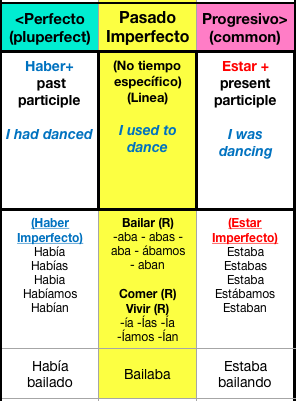
   Progressive wing waves at the future and uses a form of estar.
   Perfect wing waves at the past and uses a form of haber.

The progressive wings ALWAYS use a form of estar and the present participle (also called a gerund):
    Present tense … I dance  (bailo) … this is an action I take in the generalized present.
    Progressive present wing … I am dancing (estoy bailando). This is an action I am taking right now. It’s as close to the future as you can get without actually being in the future..

The perfect wings ALWAYS use a form of haber and the past participle.
     Present tense … I dance (bailo)
     Perfect present wing … I have danced (he bailado). This is an action that extends from the past almost into the present.

So the Present with it’s future and past wings, looks like this ... one tense you can use in three ways.


The pattern is the same for the other tenses. Of course, there are two versions of the past tense, one representing completed actions, called preterite or pretérito (I danced yesterday), and one called imperfect representing actions without completion (I danced my joy).

Paul of SpanishwithPaul calls one the "dot past," meaning that it was finished, a completed action. He calls the other one the "line past," meaning that it was ongoing. Here's a good 3-minute video to help you sort out which verb to use. 
You will sometimes hear the term "pluperfect" ... 
that refers to the Imperfect Perfect. (a bit mindboggling
but it's simplified below ... it's one of those "wing" things).


Future tense follows the same pattern, but also offers a simple way of to put an action into the future by saying "I am going to ... " using the verb ir plus a and aninfinitive. I am going to dance (Voy a bailar ... vas a bailar ... va a bailar, etc.)

And the conditional tense follows the same pattern to complete the action tenses.


There's one more oddity that you probably won't need anytime soon ... or ever.


Sometimes you need to say may want to say that you have been dancing all night ... lucky you! The grammarians amongst us would call that "perfect progressive." In Spanish you would put a form of haber together with estado and the present participle ... as follows:

He estado bailando ... I have been dancing
Hube estado bailando ... I had been dancing
Había estado bailando ... I had been dancing
Habría estado bailando ... I would have been dancing
Habré estado bailando ... I will have been dancing
 If you get this far, I suggest you go dancing!

Tuesday, March 26, 2019

Verbos: 25 Most Common Irregulars

¡Un gran obstáculo!
One of the biggest hurdles in Spanish is learning irregular verbs. As far as I know, there is no easy way to learn them other than memorizing them.

So, relax make friends with them, get to know them.

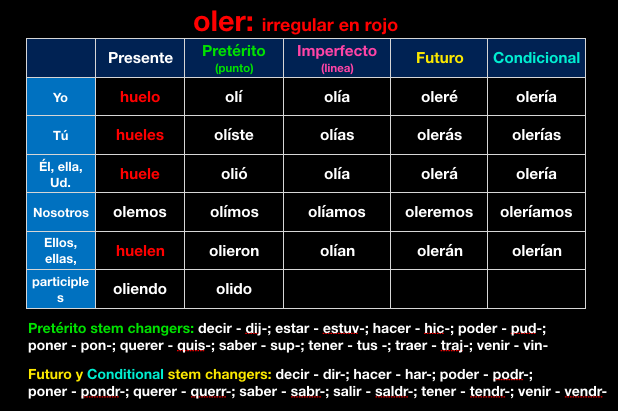
Here are the 25 most common irregular verbs on "flashcards" showing the 5 major tenses: present, the two past tenses, future and conditional.

Don't try to consume them all at once ... take 5 at a time and review frequently. Make sentences with them in each of the tenses. You will notice that some are more irregular than others.

If you click on the images, you will get a larger image that will be easier to read. The verbs are in alphabetical order to make them easier to find. You will also notice that the English translations are missing. Look up the meaning and write sentences. You need to know these verbs ... they will become old friends.

Each group will focus on one tense ... the present is the most irregular, the two past tenses are the most complicated and confusing, the future is easy, and the conditional is simple when you understand how to use it and the conjugation is a snap.  

So here's the important part ... Best way to learn verbs: WRITE SENTENCES.  Here's a process which may seem slow ... however, it is deep learning and will last as you work through the normal rough spots of learning to speak a new language.


Sentence process: aka Google Dos-Pasos
  • From your own life or interests, write sentences using each person of each tense, one tense at a time … en español. HOWEVER, only write these sentences for the irregular forms of the verb (in RED). All the other forms follow the regular conjugation rules. This will cut the number of sentences you write down dramatically.
  •  Put the sentences into Google Translate. 
  • Check each sentence to see if the English says what you intended. If it does, great! If not, tweak your sentence until it does say what you want.
  • One sentence at a time, cut and paste it into the left-side box and change the language to English.
  • Check to see if the Spanish is the same as yours. If it is, great (and unusual)! If not, figure out why there are differences. Some may be valid corrections; others may be Google Translate making changes you don’t want.
  • Highlight the changes on your sentences and insert the correct version. Over time, you will start to see patterns in your errors which will help you correct them.
  • Speak the corrected sentences OUT LOUD! 
  • Once you have your sentences for a verb written, record them and then listen to your recording. If you're not happy record them again. Read them to or record them for your teacher.
  • If you want to use words you don't know yet, get them from Google Translate, but make note of them so you can add them to your new word list in your journal. You do have a journal, don't you?
So we're off ...
Group 1: Presente -- ahorita! 
Verbos: creer - dar - decir - dormir - estar

three endings -ar, -er, -ir. Once you understand regular conjugation,
the irregulars will make more sense. 


It is difficult to have a belief that has a beginning
and an end, so most past beliefs will be imperfecto.


Group 2: Pretérito -- terminado. punto.
Verbos: haber - haber (2) - hacer - ir - oír - oler

One of the very different aspects of Spanish versus English is the use
of two past tenses, and to further complicate matters, they are known by different terms.
We're using the Spanish terms. To help simplify the two, Paul of SpanishwithPaul
calls them the "dot past," meaning that it was finished, a completed action.
He calls the other one the "line past," meaning that it was ongoing.
For instance: I danced yesterday. (dot) Ayer bailé.
I used to dance a lot. (line) Bailaba mucho.
Don't worry, it will take awhile.
For now, let's focus on  the "dot past" - pretérito.
Write sentences using these words about actions you completed
sometime in the past.

Here's a video from language master Olly Richards
and his Fluent Spanish Academy which will help you understand
conjugation of some of the most irregular verbs in the
pretérito tense.


Group 3: Imperfecto -- habitos ... lineas
Verbos: pedir - pensar  - pagar - poder - poner

Things you used to do ... habits, repeated actions in the past. 
Fumaba. ;-(
It's tricky to decide which verb you need to use, but the lovely
thing about this tense is that there are only three irregulars:
IR - SER - VER
and none of them are in this group.
Here's a good 3-minute video to help you sort out 
which verb to use. After you watch it, you will be
ready to write sentences.

It's as simple as pizza!


It is difficult to have a thought that has a beginning
and an end, so most past thoughts will be imperfecto.


Group 4: Futuro -- mañana
Verbos: querer - saber  - salir - sequir - sentir

The future tense is easy to use and easy to conjugate.
You probably already know how to use an even simpler
future form ... voy a (infinitive) which is great for actions that will
take place in the immediate future.  However, for actions that will
take place sometime in the indefinite future, you need the future tense.
There are a few verbs which change their stems in future and conditional
tenses and they are noted at the bottom of each flash card.


Group 5: Condicional -- ¿posible?
Verbos: ser - tener  - traer - venir - ver
The conditional tense is actually quite useful and way easy
to conjugate, using the same three irregulars as the future tense:
IR - SER - VER.
This short video by language master, Olly Richards, shows you how to use
the four basic reasons for using this tense ... setting up possibilities,
asking for advice, giving excuses, and being polite.

It's especially important to write sentences with this tense
to make sure you know how to incorporate it into your conversations.


If you've finished this series,
it's time to 
GRAZNAR!


 Feel free to take a screen shot of this image
and paste to social media ... you deserve it.

and

please leave a comment below ... tell us what you think about this exercise ...
and how many sentences you wrote.


Monday, March 25, 2019

Verbos: Pretérito vs Imperfecto

Señor Jordan vídeo
It seems simple enough, just like this video clip says. 

However, when I realized how many mistakes I was making, I decided to go to YouTube for help.

I love this video because it combines listening, reading, vocabulario and clarification on this grammar point.

Señor Jordan vídeo #2
And, even better, he has two videos to give us even more insights into when to use each words. My take away is that preterite is more concrete, more recognizable than. If I can't say that the action is definitely over with, it's probably imperfect. 

Anyway, that's going to be my strategy for now.

Saturday, March 23, 2019

Verbos: Top 25 reflexive verbs

It's good to remember that it is the intended meaning and the pronoun that makes a verb reflexive ... the actual conjugation remains the same. Reflexive verbs reflect back to the subject agent.

In this example, levantar which normally means raise or lift, when reflexive it means to stand up. Me levanto - I stand up. Se levanta - he or she stands up; se levantan - they stand up. Verbs that change meaning are highlighted.


Reflexive verb
English
Non reflexive

1
irse
to leave
ir
to go
2
acordarse
to remember
acordar
to decide, resolve agree
3
sentirse
to feel
sentir
to feel or regret
4
darse
to give (oneself)
dar
to give 
5
encontrarse
to find (oneself)
encontrar
to find
6
quedarse
to stay behind, remain, stay in hotel
quedar
to be left
7
ponerse
to put on
poner
to put
8
imaginarse
to imagine
imaginar
to imagine
9
referirse
to mean
refer
to refer
10
hacerse
to become, make yourself
hacer
to make or do
11
preocuparse
to worry
preocupar
to worry
12
fijarse
to take notice
fijar
to fix, fasten, secure
13
atreverse
to dare to
atrever
to dare
14
casarse
to get married
casar
to marry, join in marriage
15
verse
to see oneself
ver
to see
16
sentarse
to sit down
sentar
to sit
17
preguntarse
to wonder
preguntar
to ask
18
levantarse
to get up; stand up
levantar
to raise or lift
19
enterarse
to find out
enterar
to inform
20
dedicarse
to dedicate to
dedicar
to dedicate
21
decirse
to say (to oneself)
decir
to say or tell
22
llamarse
to call (oneself)
llamar
to call
23
meterse
to get into
meter
to put in, insert
24
reunirse
to get together
reunir
to gather, collect
25
creerse
to believe self
creer
To believe